
| SNCF |
| Projet ELAN à la SNCF |
| Contexte du projet ELAN |
| Objectif du projet ELAN |
| Périmètre du projet : |
| Solution : |
| Coopération de recherche SNCF/CRI |
| Contexte de recherche |
| Problématique de recherche |
| Solution proposée |
|
les requirements de l'organisation en termes d'objectifs et de stratégies nécessaires pour les réaliser ; |
|
les fonctionnalités de l'ERP en termes d'objectifs qui peuvent être atteints par la mise en place de l'ERP et par les différentes manières et moyens pour réaliser ces objectifs. |
|
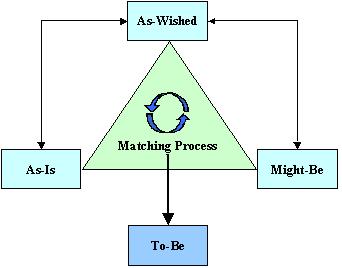 |
|
Le modèle As-Is qui représente la situation actuelle à la SNCF. Il comprend l'ensemble des processus supportés par le système d'information actuel [SNCF03]. |
|
Le modèle As-Wished qui représente la situation cible souhaité par la SNCF après la mise en place de l'ERP [SNCF03]. |
|
Le modèle Might-Be qui représente les processus supportée par l'ERP en standard [PeopleSoft]. |
| Méthodologie de recherche |
| Résultats |
|
Modélisation de la situation existante (As-Is) |
|
Modélisation de la situation cible (As-Wished) |
|
Modélisation des fonctionnalités de l'ERP (Might-Be) |
|
Le matching entre As-Is, As-Wished et Might-Be afin de produire la carte To-Be. |
| Références |
| [Alves02] C. Alves, A. Finkelstein. Challenges in COTS-Decision Making: A Goal-Driven Requirements Engineering Perspective. In Procs of Workshop on Software Engineering Decision Support, in conjunction with SEKE'02. Ischia, Italy, July 2002. |
| [Arsanjani01] A. Arsanjani, J. Alpigini. Using Grammar-oriented Object Design to Seamlessly Map Business Models to Component-based Software Architectures. In Procs of the International Symposium of Modelling and Simulation, May 16-18, 2001, Pittsburgh, PA, USA, pp 186-191. |
| [Dick02] B. Dick. Action research: action and research (On line). Available at http://www.scu.edu.au/schools/gcm/ar/arp/aandr.html , 2002. |
| [Nurcan04] S Nurcan, A. Etien, R. Kaabi, I. Zoukar. A Strategy Driven Business Process Modelling Approach. To be published in Business Process Management Journal, A Special Issue On Goal-Oriented Business Process Modeling. |
| [PeopleSoft03] www.peoplesoft.com |
| [Rolland00] C. Rolland, N. Prakash. Bridging the Gap Between Organisational Needs and ERP Functionality in Requirements Engineering Journal, 5(2000). |
| [Rolland01] C. Rolland, N. Prakash. Matching ERP System Functionality to Customer Requirements. In Procs of the 5th IEEE International Symposium on Requirements Engineering, Toronto, Canada. August 27-31, 2001. |
| [Salinesi03] C. Salinesi, C. Rolland. "Fitting Business Models to Software Functionality : Exploring the Fitness Relationship " Proceedings of the 15th Conference on Advanced Information Systems Engineering, (CAISE'03), Springer Verlag (pub), 2003. |
| [SNCF03] documents internes. |
| [Zoukar04a] I. Zoukar , C. Salinesi. Engineering the Fitness Relationship between an ERP and the Supply Chain Process at SNCF. Submitted to 15th Information Resource Management Association International Conference, New Orleans, Louisiana, USA, 2004. |
| [Zoukar04b] I. Zoukar , C. Salinesi. Matching PeopleSoft Functionalities with SNCF Logistic Requirements: A Similarity Approach. Submitted to 6th International Conference on Enterprise Information Systems, Porto (Portugal), 2004. |