Objective:
The objective of this chunk is to help the Requirement Engineer (RE) in
understanding a goal expressed in an informal manner and in reformulating
it formally. A goal expresses a requirementthat the system shall fulfil.
-
Situation
: Goal
To attain this objective following the guidelines provided by the chunk,
it is necessary to start with a goal which has been elicited before
in the RE process. This goal is expressed in an informal manner.
-
Intention
: Elicit a
goal with linguistic strategy.
The intention is to transform an informal expression of a goal into
a formal one and therefore, to help eliciting a new goal. A linguistic
approach defining a goal as a verb with associated semantic functions
is used to support this elicitation.
-
Graphical
Representation :
Description :
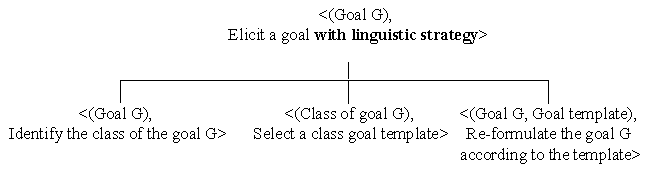
As depicted in the graphical representation of the chunk, the body
of the chunk is a plan contxt which suggests to proceed in three steps
as follows:
The RE shall identify first the class in which the given goal G belongs
<(Goal G), Identify the class of the goal G>. For this, he/she
uses the goal hierarchie presented below. Then, the RE selects the goal
template attachet to the identified class of goals <(Class of goal
G), Select a class goal template>. And finally, he/she re-formulates
the goal with a statement mathching the selected goal temlate <(Goal
G, Goal template), Re-formulate the goalG according to the template>.
The underlying linguistic approach of this chunk is based on the three
following assumptions :
1. A goal
is formalised as a verb followed by parameters, each parameter having a
semantic function like below :
Object( Obj): The entity/entities
or goal(s) affected by the goal. The object exists prior to the goal's
achievement and may be modified or
suppressed by it.
Result (Res): The entity/entities
or goal(s) which are effected by the goal, which result from its achievement.
As opposed to the object case, the entities/goals of the result case do
not exist prior to the goal, or they exist only in abstract form and are
made concrete as a result of the goal's achievement.
Source(So)
: The starting point (information source or physical place) of the
goal. This case implies movement.
Direction (Dir): The terminal
point of the goal. This is the opposite of the source case.
Reference (Ref): The entity
with regard to which an action is performed, or state is attained or maintained
Manner (Man): specifies
the way in which the goal is to be achieved.
Means (Mea): specifies the
entity (tool...) by means of which the goal is to be achieved.
Quality (Qual): a quality
which is to be attained or preserved.
Beneficiary (Ben): the person
or group in favour of whom the goal is to be achieved.
Location(Loc): situates
the goal in space. This case implies no movement, or movement within the
same location.
Time(Time): situates the
goal in time.
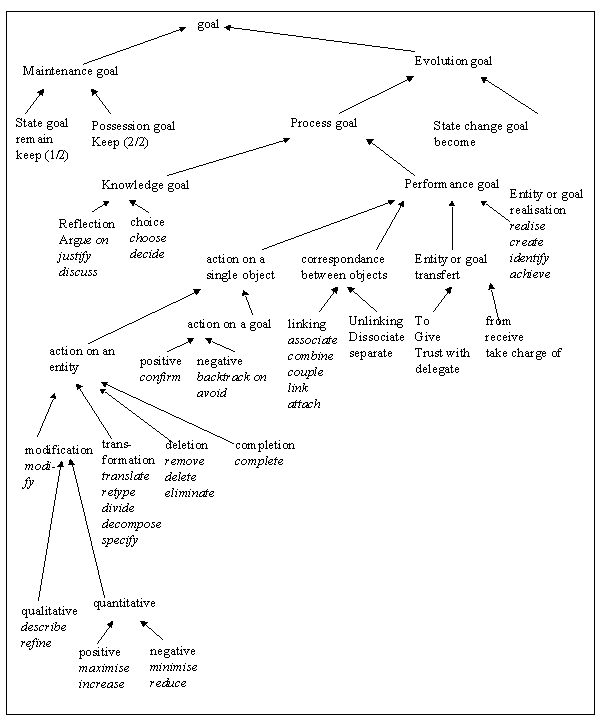
2. A taxonomy of verbs can be defined and organised
in a hierarchical manner. This taxonomy is constructed considering
in one hand, the semantics of the verbs and on the other hand, their semantic
functions.The hierarchy is presented in the figure below. As shown
in the figure, the first level of the hierarchy distinguishes between maintenance
and evolution goals. The former refer to static verbs (e.g remain.....)
whereas the latter are verbs expressing dynamics (e.g become, achieve....).
Evolution goals are further refined between process goals (e.g create...)
and state change goals (e.g become....). Process goals encompass intellectual
activities (e.g knowledge goals) and performance (action goals) etc..
3. Every class of the hierarchy may be characterised by
a specific set of semantic functions. In other words, a goal template can
be defined for each class of verbs in the hierarchy. This is useful because
all the possible parameters of a verb statement are not holding for every
goal. For example, the verb template for "remain" is
remain[Qual, (Ref), (Location),(Time)].
This template means that the verb "remain" may be followed by four
parameters, namely quality (which is mandatory) and referent, location
and time which are optional. It shall be noticed that the same verb
may appear several times in the hierarchy because it has several meanings.
This is the case for the verb "keep" that is attached to two different
nodes of the hierarchy and has two different goal template, one for each
node. The table below associates to each class of goals of the hierachy
shown above the corresponding goal template.
table
Example
-
Aggregates :
-
Origin :
CREWS-L'Ecritoire
approach
Centre
de Recherches en Inforamtique,
Université
de Paris 1 - Panthéon-Sorbonne
N. Prat, Goal formalisation and classification for requirements engineering.
Proceedings of the Third International Workshop on Requirements Engineering:
Foundations of Software Quality REFSQ’97, Barcelona, pp. 145-156, June
1997.
-
Tutorial Support : The
process is supported by a software tool called L'Ecritoire.
-
Reuse context :
-
Application Domain : Information
Systems, Human Computer Interfaces, Socio-Technical Systems, Business Processes
-
Design Activity : Requirements
Elicitation
-
Intention : Formulate
system requirements
